Recommended Areas to Stay in Tokyo

Happy Aloha Friday!

First-time travelers to Tokyo, maybe even those who have traveled to Tokyo a couple times, might not be sure which area they should set as their base camp. Depending on the type of experience you’re searching for, your travel itinerary, and, of course, your wallet.

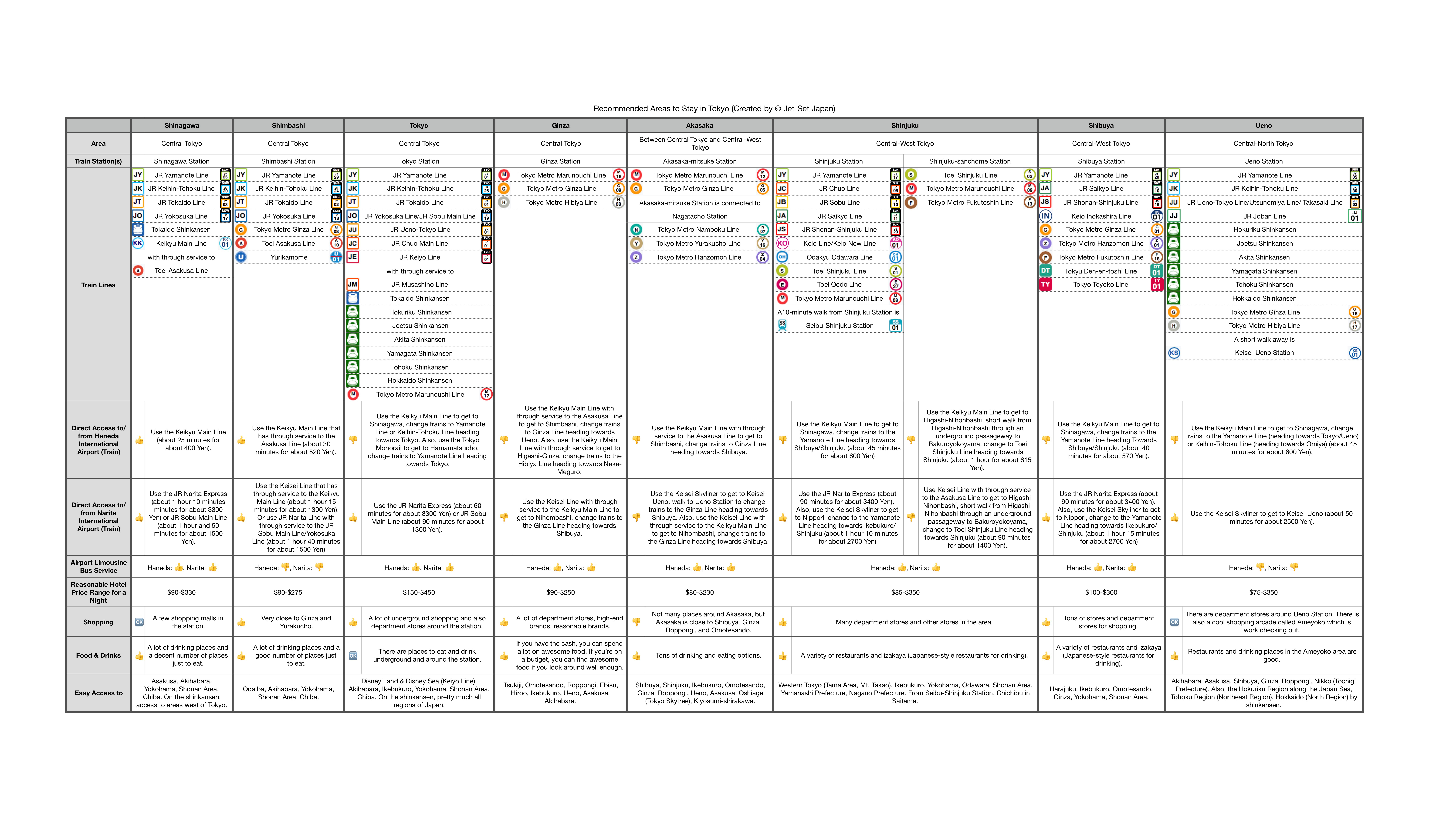
Here is a list, in no particular order, of train stations that we recommend to stay near when you visit Tokyo. The list is an image, and there is a lot of info. So, click on the image for high-resolution or you can download the image.
recommended-areas-to-stay-in-tokyo.jpg

In a nut shell, we recommend the following areas: Shinagawa, Shimbashi, Tokyo (Station), Ginza, Akasaka, Shinjuku, Shibuya, and Ueno. Each area has its own characteristics which appeal to different people. For example, Shinagawa, Shimbashi, and Tokyo are extremely convenient areas because of their access to different train lines, and all three have an image of being major hubs for business people. If you compare the three, Shimbashi has the strongest image of drinking; Tokyo has the most elegance; Shinagawa might actually be low-key compared to the other two.

Akasaka is not a major hub for business people, but there are a lot of companies, government institutions, etc. in the area, so streets in evening will be full with people looking for a place to drink.

Ginza, like Roppongi, Aoyama, Omotesando, is considered to be a high-class area. But even in these areas, there’s always reasonable and quality places to shop and dine.

Shinjuku and Shibuya are geographically next to each other in Tokyo, but Shibuya has an image suited more towards the younger generation (not saying that Shinjuku is for older people). Both areas have a lot of shopping, eating, drinking options, but a lot of visitors to Tokyo are attracted to Shibuya’s “scramble crossing”.

Ueno is located in Tokyo’s shitamachi (old downtown) area, so the atmosphere is different to other areas of Tokyo mentioned above. Ueno is close to Asakusa, and Asakusa has a nice “nostalgic” feel with its shopping arcades.

For more detailed information, check out the list above!
Getting Around Japan ー Trains, Buses, Taxis/Uber, and Walking

Trains/Subway

This is the most common way of getting around most areas. The train/subway system in large cities looks complicated because of the various train/subway lines and large number of train stations, but it is a very efficient and convenient system. Based on this fact, we’ll offer a few tips for travelers:

  1. Avoid rush hour (if possible): Depending on which area of Japan you are traveling in and which train line you want to take, rush hour will be different times of day. Generally, rush hour is from 6:30am-9:00am and 5:00pm-7:00pm. If you think you can take your suitcase(s) on a train during rush hour, you will have a terrible experience of trying force your way on to a packed train with every passenger in the area looking at you.
  2. Purchase a chargeable “IC Card”: The most well-known IC Card is JR’s SUICA, but each region Japan has it’s own IC card, so it is kind of a collectable item as well. After purchasing an IC card, you can charge it up with money and not only go through the automated gates after swiping your card over the reader, you can also use it at stores to buy things. We usually use IC cards to buy things at convenience stores (7-Eleven, Lawson, Family Mart, etc.) when buying beer, food, and other stuff.
  3. Get a JR Pass if you are going to ride the shinkansen: There are two types of JR Passes: Green Car and Ordinary. The Green Car pass is more expensive because you can reserve seats in the “Green Car”, which is a first-class. To be quite honest, Ordinary passes are good enough because seats in “economy” class on a shinkansen are comfortable enough, and I’d rather spend my money on eating awesome food. Also, both the Green Car and Ordinary passes are available as a 7-day pass, 14-day pass, or 21-day pass. You can validate your pass within one month from receiving your pass, so you can validate your pass depending on your travel plans.

Buses

In short, buses will take you where trains are not available. In Tokyo, many buses connect areas that have train stations which are not directly connected by a train line. In other areas, buses connect train stations with sightseeing areas and/or residential areas. Buses are usually on time, but it’s good to always arrive a little early just in case.

Taxis/Uber

I used taxis frequently after getting surgery on my leg, and it’s a great way to get around if you have cash and want to enjoy your personal space. When you hail a taxi in Japan, the taxi driver will open the door by the push of a button from driver’s seat. If you don’t speak Japanese, we recommend having a note of the address of where you want to go because taxi driver’s can use their car navigation to take you to your destination. In Tokyo, because of the upcoming Olympics, many taxi companies have implemented multilingual “communication sheets” so customers can, perhaps, smoothly communicate where they want to go. If you speak Japanese and want to get some recommendations for anything, taxi drivers are great sources of information!

Regarding Uber, I haven’t used it in Japan, but it is available. It might be good to use Uber after late at night after trains have stopped and when taxis are more expensive and all taxis already have a fare.

Walking

Walking is a major part of traveling in Japan. On average, we walk 5-8 miles a day, so if you are not in shape, we recommend doing some light walking. Taking this into consideration, planning out the places you are going to visit along with places you can take breaks (lunch, tea, coffee, alcohol, etc.) will help with making your trip more enjoyable.

This topic is just an introduction to getting around Japan, so we will write more about some of these topics in the future.