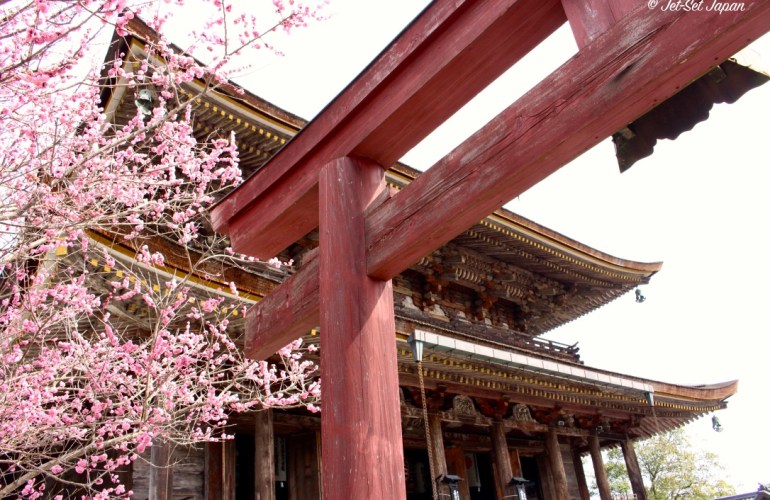
Featured picture is of Kinpusenji Temple in late March with ume (plum) blossoms.
In this post, we will introduce 3 things about traditional Japanese Culture: castles, temples, shrines.
Castles
Throughout Japan’s history, there was a long period where the country was feudalistic. Daimyo (feudal lords) ruled not only their land and people, but they also controlled their own armies. These powerful feudal lords built castles to protect their territory. In the pictures above, there are pictures of the castle keep and various areas of the main castle grounds, but in history, the castle referred to the surrounding area (castle town). When visiting a castle, the interior is usually a small museum where you can find historical facts about its history. If you want to see nice views of the surrounding city, you can go all the way to the top of the castle keep. Just be careful of strong winds!
Temples
A lot of people confuse temples and shrines, but here is the easiest way to differentiate the two: shrines have torii gates (check pictures below); temples don’t have torii gates. However, there might be a shrine on the temple grounds. In one of the pictures above, you can see a small, orange torii gate on the left of the main hall of Kinpusenji Temple. The other picture is of Zojoji Temple, which is near Tokyo Tower.
Shrines
Now that we know structural difference between a shrine and a temple, let’s take a look at the religious difference. Temples = Buddhism; Shrines = Shinto. Shinto has many gods/deities, and different gods/deities are enshrined at different shrines. The most divine shrine in all of Japan is Ise Grand Shrine. Amaterasu, the God of the Sun, is enshrined there. Another extremely important shrine is Izumo Shrine. This shrine was dedicated to Ookuninonushi (Grand Master of the Land), who is the god of building the land, amongst other things. In this aspect, Shinto is similar to Hawaiian mythology because Hawaiian mythology has many gods who have different powers, authority, and personalities: Amaterasu is like Pele.
When visiting castles, temples, and shrines, visitors should always mind their manners, but it is hard to do so if you don’t know what to do. We’ll write blog posts in the future about manners at certain places.
We’ll also write posts about other topics!
Mahalo for visiting today!
 Jet-Set Japan