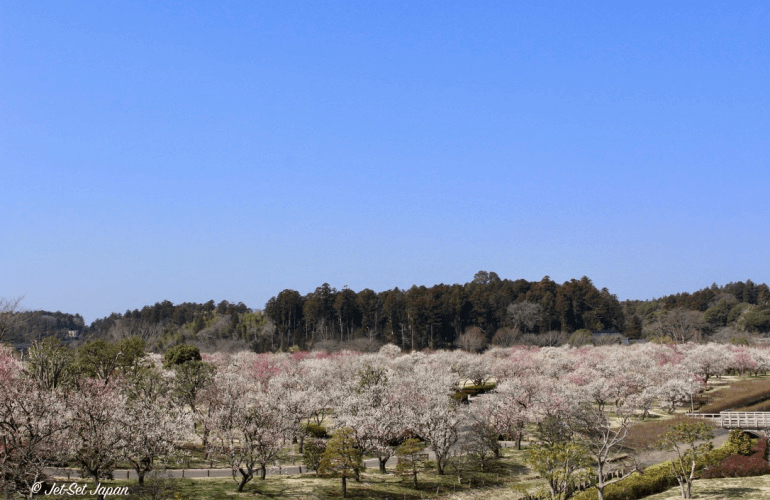
The most famous of all Japanese gardens are the Three Great Gardens of Japan (日本三名園, Nihonsanmei-en): Kairakuen (偕楽園), Korakuen (後楽園), and Kenrokuen (兼六園). In this post, we will show a couple of pictures we took at each garden and give some useful info.
Kairakuen (偕楽園)
Location: Mito City, Ibaraki Prefecture (Kanto Region)
Access: From Tokyo, Mito Station (and the temporary Kairakuen Station) can be reached by taking the Joban Line, which is run by JR and stops at Shinagawa Station, Tokyo Station, and Ueno Station. Limited express trains cost more, but will get there in about an hour, which is about half the time of ordinary trains.
- From the North Entrance/Exit of Mito Station, take a bus from bus stop 4 (bus heading for Kairakuen; get off at Kobuntei Omotemon, Kairakuen Higashimon, or Kairakuen-mae) or 6 (bus heading for Kairakuen). Bus takes about 15-20 minutes.
- During the plum blossom festival during spring, there is a temporary station called Kairakuen Station. So Kairakuen can be accessed by foot.
Price: Free. 200 Yen to enter the Kobuntei.
Must-see: Plum Blossom Festival (Ume Matsuri) which is usually held from mid-February to late-March. Depending on the weather, best-viewing dates differ from year to year. We will write a post about this in the future.
Recommended trip plan: A day-trip from Tokyo. Leave in the morning so you can arrive mid-morning. Enjoy the garden for a few hours, and then return to Tokyo before dinner.
Korakuen (後楽園)
Location: Okayama City, Okayama Prefecture (Chugoku Region)
Access: From Tokyo Station by shinkansen, about 3 and a half hours. From Shin-Osaka Station by shinkansen, about 1 hour. From Hiroshima by shinkansen, about 45 minutes. Note that these times are calculated for those using a JR Pass, which restricts users from riding the fastest trains (Nozomi, Mizuho, etc.).
- From the East Entrance/Exit of Okayama Station, take a bus from bus stop 1. Non-stop buses from this bus stop to Korakuen are available. Bus takes about 10 minutes.
- From Okayama Station, take the city tram heading for Higashiyama, and get off at Shiroshita. About a 12 minute walk from Shiroshita.
Price: 400 Yen for just Korakuen. Combination ticket for Korakuen and Okayama Castle is 560 Yen. Combination ticket for Korakuen Okayama Prefectural Museum is 520 Yen. Combination ticket for Korakuen, Okayama Castle, and Hayashibara Museum of Art is 960 Yen.
Must-see: As you can see from the panorama picture above, Korakuen has large lawns surrounding its ponds. This give the garden a much more spacious atmosphere. You can also by a combination ticket for both Korakuen and Okayama Castle. There are also combination tickets for Korakuen and Okayama Prefectural Museum, and Korakuen, Okayama Castle, and Hayashibara Museum of Art.
Important: There is an area in Tokyo called Korakuen, and this area has a baseball stadium, amusement park, and a Japanese garden called Koishikawa Korakuen. This is not the Korakuen we are talking about! The Korakuen we are talking about is located in Okayama Prefecture.
Recommended trip plan: A day-trip from Hiroshima. Leave Hiroshima in the morning so you can walk around the garden and/or castle mid-morning. Have some lunch around Okayama Station before heading back to Hiroshima or moving on to another area, perhaps Osaka.
Kenrokuen (兼六園)
Location: Kanazawa City, Ishikawa Prefecture (Chubu Region, Hokuriku Region)
Access: From Tokyo Station by shinkansen, about 3 hours to Kanazawa Station. Note that these times are calculated for those using a JR Pass, which restricts users from riding the fastest train on the Hokuriku Shinkansen (Kagayaki).
- From the East Entrance/Exit of Kanazawa Station, take a Hokutetsu bus from bus stop 6 (Kenrokuen Shuttle) or 7 (Kanazawa Loop Bus) and get off at Kenrokuen-shita/Kanazawa Castle. Hokutestsu has a 1 day bus pass for 500 Yen.
- JR also has buses running from the East Entrance/Exit of Kanazawa Station, so you can use your JR pass, but the Hokutetsu is more convenient because they have buses running more frequently.
Price: 310 Yen
Must-see: If you go to Kanazawa before or after the large amount of snowfall, you can still see yukizuri that protect the trees from snow. Kanazawa Castle is also next to Kenrokuen. The Higashichaya District and the Oumicho Fish Market in the vicinity. You can walk to Higashichaya District from Kenrokuen, but it takes about 20 minutes on foot. There are taxi stands around the garden, so if you share a taxi with your friends, it’ll save a lot of time. We will write a post just about Kanazawa in the near future.
Recommended trip plan: A little far for just a day-trip, but it is possible if you leave early in the morning. However, we think you should stay at least one night Kanazawa because they have A LOT of great food.
This is our brief introduction of Japan’s three fantastic gardens. For all gardens, try to visit during Spring, Summer, or Fall, but don’t visit too early in Spring because you might miss all of the beautiful greenery, even though there are many nice structures and landscaping to look at during winter.
 Jet-Set Japan